17:42 by
lowflyingowl
, under
Argentina,
bolivia,
chile,
database,
folklorico,
history,
huayno,
information,
peru,
south america
While looking into the background of the various CDs and new genres I have aquired, I discovered a really great resource for Latin American music, or more specifically Andean music. Pacoweb is a site full of info on artists, discs, styles, dances and instruments (in Spanish). Check out the Ritmos Sud Americanos part which lists and explains the hundred of rhythms and variations of the numerous styles. It lists around 49 variations of Huayno!!!

|


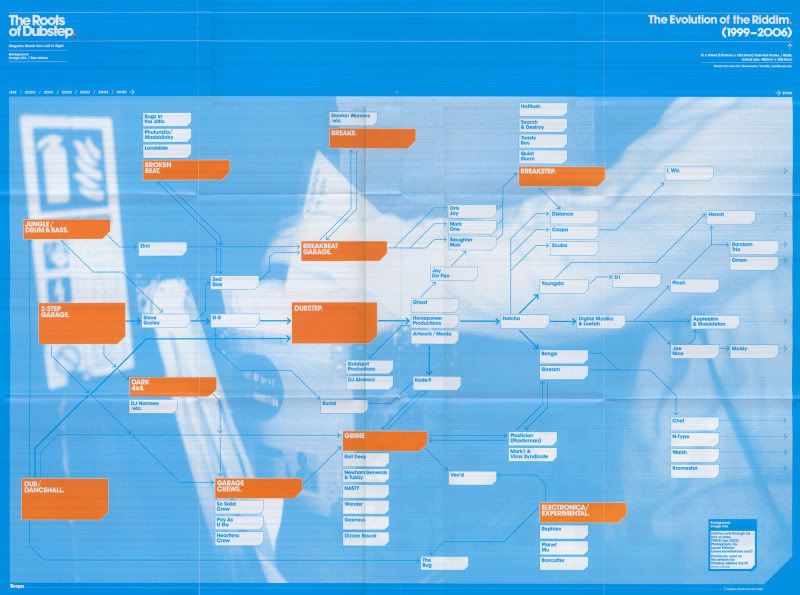
Inside cover to The Roots of Dubstep
|
Since it's emergence nearly a decade ago the term dubstep has always been open to interpretation, indeed that was one of the enticing things about the sound. Many have tried to define the style, stating that dubstep uses the snare on the third beat, heavy bass weight, wobble, standard quote from film etc etc. Indeed many dubstep tunes fit this description to a glove, however, it has become an umbrella term for a host of artists making tunes around 140BPM. There are the Ruskos, Cokis and Caspas making near chainsaw dub, aggressive tunes filled with drops and ready for the rewind (An amusing take on these guys by Mr Simon Reynolds in the Guardian in which he called Caspa "The Guy Ritchie of Dubstep" Forum bait,) the synthy madness of Zombie and the Purple Trinity (Joker, Guido, Gemmy), the tech-influenced 2562, TRG, Headhunter, Pevrelist, the dub influenced Mala, RSD, Mungo's Hi Fi, the many arriving from the D'n'B scene, not to mention the countless artists working somewhere in between (where do you put Hyperdub Records?!).

The emergence of the sound and it's structure comes from the dark 2-step garage which emerged at the start of the decade, associated with Ghost Records and artists such as EL-B, Horsepower Productions and Steve Gurley. For an introduction check out the Roots of Dubstep CD on Tempa or United Vibes History of Dubstep Mix. Equally, another, far superior Reynolds' article which appeared in The Wire back in the day is great read charting the progression of UK garage, 2-step etc.

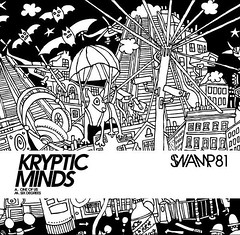
Loefah, of DMZ fame, recently set up Swamp 81 Records (named after the Met police's stop and seach operation which caused the 1981 Brixton Riots), an outlet for the dark, rolling 2-step garage sound in the context today's dubstep scene. The excellent Blackdown blog has an interview with Loefah and Kryptic Minds, who are heading the first Swamp 81 releases. It sums up Loefah's thinking behind setting up the label and his reflections on the scenes progression. Listening to a preview mix (DL here) of the new Kryptic Minds stuff is dark. It is futuristic, murky 2-step, full of atmousphere, clicks and rhytmic urgency. As Reynold's ends his article, written in 1999: "two-step sounds like it has a whole world of places left to go." He was right.

Kryptic Minds Studio Mix - DL here
Kryptic Minds - Untitled - Osiris Music uk Dub
Kryptic Minds - The Weeping - Disfigured Dubz Dub
Kryptic Minds - Untitled - Osiris Music uk Dub
Kryptic Minds - Untitled - Osiris Music uk Dub
Leon Switch - Latin Dub - Osiris Music uk Dub
Kryptic Minds - Wondering Why - Osiris Music uk Dub
Kryptic Minds - Untitled - Osiris Music uk Dub
Kryptic Minds - Unititled - Osiris Music uk Dub
Leon Switch - Untitled - Osiris Music uk Dub
Kryptic Minds - Three Views Of A Secret - Swamp 81 Dub
Kryptic Minds - Mercury Rising - Dub
Kryptic Minds - Bad Man - Dub
Kryptic Minds - Rubberman - Dub
Leon Switch - Untitled - Dub
Kryptic Minds - Dissolved - Swamp 81 Dub
Kryptic Minds - One Of Us - Swamp 81
Kryptic Minds - Organic - Swamp 81 Dub
Kryptic Minds - Follow Me - Dub
|

I have been a big fan of DJ/Rupture ever since I heard his Gold Teeth Thief and Minesweeper Suite mixes/albums/creations. His blog is full of all sorts of random musical journeys and I hear his DJ sets aint bad. It seems he also wrote one of the best articles I have read on cumbia and more specifically, cumbia in Argentina (for an american, this man knows his cumbia.) It appeared in The Fader back in July/August 2008. Here is an extract:
The 2001 economic crisis saw the real value of the Argentine currency plummet by seventy-five percent. Folks with $100,000 in the bank suddenly had $25,000. The underclass hemorrhaged, rich turned poor. Who could stomach flowery love songs after that? This nasty reality slap boosted cumbia villera’s popularity to astronomical heights. “The villa is in a state of emergency,” says Lescano. “A kid dies in the villa and it doesn’t matter. You say ‘black’ not for the skin color but for the barrio you live in.” The lethal popularity of a cheap new drug called paco (like crack, but worse—few addicts survive past six months) has made edge living even more raw. But a bizarre umbilical connects freedom and neglect. Even though cumbia has maintained incredible popularity across South America for decades, its mala reputación meant that it never garnered much external interest. Cumbia kept growing, with nobody to answer to but its fans and followers.
Read the full article here.
|
A music genre is a category (or genre) of pieces of music that share a certain style or “basic musical language” (van der Merwe 1989, p.3). Music may also be categorised by non-musical criteria such as geographical origin though a single geographical category will often include a wide variety of sub-genres (Music News Review)
I was thinking recently what with this global exchange of music that it would be interesting to create some kind of chart, a comprehensive guide to music and it's roots. Plotting influences, genres, movements etc. I imagine it would consist of lots of arrows and names. I started to dig around google and try out with different search terms. There is Ishkur's Guide to Electronic music but it is all tongue in cheek and now feels a bit outdated. Then I found this chart (Wikipedia) which resembles more or less what I had in mind, it is a graph of cuban music with extras added in.

I then found this blog: Digital Music Collector who is in the process of constructing a music genre map, a very comprehensive one by the sounds of things.

Obviously it should be merely a guide which traces the evolution of music but does not constrain or attempt to define artists etc. But for example the evolution of cumbia, the roots of Reggaeton, tango's Italian/spanish/folkloric influences. The possibilities are endless and especially if it was user friendly or possibly Wikipedia-ish, in that users could update information, provide descriptions, new genres (all monitored, to an extent.) Also sites like LastFm could link into the information for users listening, music players could use the genre tag and link to the site. Etc etc. If anyone is interested or would like to offer support to the programmer behind the Music Genre Tree site contact here: Contact
|